
Find The Best Attorney For Your Case
(312) 346-5320 or (800) 517-1614
Free Consultations - 24/7
No Appointment Needed, Just Call

Criminal Defense in Illinois

I’ve been helping people find the right lawyer for their case since 2001.  I’ve helped almost 400,000 people and I almost never see a situation where I don’t know a lawyer for the person who needs help.

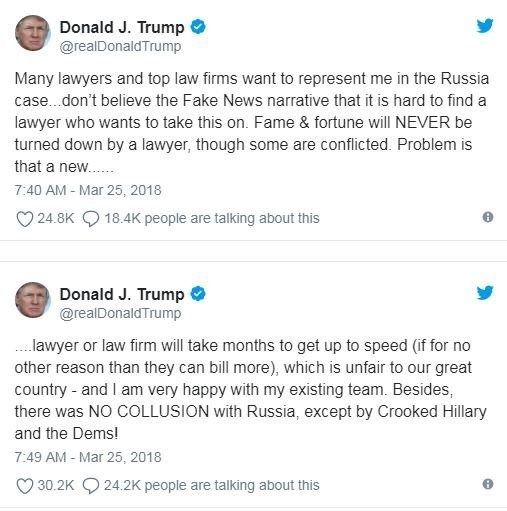
But I’ve come across a person who is so difficult that he keeps losing lawyers.  He claims to have a lot of money and it’s a really high profile case.  Attorneys love clients with money and they love high profile cases, but nobody wants to go near this case.  This guy not only claims to be hugely rich, but also says that everyone says so.  Yet top criminal attorneys like Dan Webb want nothing to do with him.

Part of the problem is that this potential client thinks he’s smarter than every lawyer out there.  He doesn’t need their advice because he knows more about law than all of them.  Everyone says so he claims.  When the lawyers tell him to stop tweeting about his case because it makes defending him more difficult and increases the chances he will be charged and convicted of a crime he shows them who’s boss and just tweets more.

It’s not too hard of a job really.  The number one thing a lawyer would have to do is prevent him from testifying under oath because if he does he will surely get charged with perjury and not the “it depends what the definition of “it” is type of perjury.  In fact, given how often he’s been sued in his life, it’s kind of a miracle that he hasn’t gone down for perjury already.

What qualifications does a lawyer need to represent this amazing client who can’t find a lawyer that wants his case?  Getting on Fox News would be a good start. Not being an uggo like Ted Cruz’s wife or a fatso like Rosey would certainly help, unless you are a man then you can look however you want.  The biggest qualifications would be the ability to silently listen as your client regales you with stories of the different women who want to f him, the people he knows who are total losers and on some days, stories of classified national secrets.  Knowledge of international finance laws and the Logan Act are probably helpful too.

Bonus available if you have no problem with your advice being ignored and getting yelled at for delivering bad news.  The client allegedly is worth billions, but would prefer to have you bill him and pay later as he says he always pays his contractors except for the losers and haters who he will gladly pay once he gets sued.

Interested parties can apply in person at 1600 Pennsylvania Ave or just @ him and see how that goes.  Act fast as many top law firms and lawyers want to represent him despite none of them actually doing so.

Recording a police officer is illegal, right? Not anymore. According to an amended Illinois law 720 ILCS 5/14-1, citizens now have the right to record any police officer without their consent. Apparently this amendment is a step in a good direction, however there are some areas that citizens need to be aware of before they decide to video tape that traffic stop.

One of the exceptions to the legality of recording a police interaction is called the surreptitious exception. This means you may not secretly record the interaction. The issue with this exception is that typically if someone is aware you are recording them, they will probably change their behavior.

The other exception is called the reasonable expectation of privacy. This is hard to prove for the simple reason that it is very hard to imagine a police officer would expect privacy during any interactions with a citizen.

One of the steps backwards with this amendment is that it allows for officials to be able to eavesdrop on private conversations and use them without a warrant. One of the steps forward is citizens who are found guilty of recording a police officer will now have less of a penalty.

Before you decide to record any police interaction under this newly amended law, make sure you are aware exactly what your rights are and what the penalties may be. This will save you from being the guinea pig in legal action that has not yet come under the scrutiny of the courts.

A common request we get when people call us looking for an attorney referral is to find a “cost effective” lawyer. We get that. We don’t like to spend more than we have to on anything.

That said, lawyers in Illinois, at least the ones that we know, do not work on a sliding scale or charge based on your income. It’s not much different than going to a restaurant. The price is what it is and you can either afford it or not. It sounds harsh, but it’s true and we always tell the truth.

So unless you were injured where an attorney will work on a contingency basis, which means they only get paid if they win, you have to pay an attorney what their rate is.

This isn’t a big deal for most people if it’s a minor issue like a traffic ticket. It becomes a problem for some people when it comes to getting a divorce where you usually need at least $2,000.00 up front in order to hire a good law firm.

But it’s a huge problem if you or a loved one is charged with a major crime like murder.

There simply is no such thing as a low cost murder defense lawyer in Illinois. If you get convicted you are obviously going to be in jail for a very long time if not for the rest of your life. So you need an attorney who has a track record of having defended these cases before.

Beyond that, there is a ton of work that needs to be done to defend one of these cases. We are talking hundreds of hours of work. So the attorneys we know of charge between $50,000.00 and $100,000.00 to take on a client. That’s a ton of money.

Most people can’t afford this amount and I don’t blame them one bit. What you can’t do is find a cut rate lawyer who won’t actually do the work. It would be a HUGE waste of money. So what do you do?

The only realistic option is to get the Public Defender who is appointed by the Judge to defend you. While lawyers in that office are over worked and underpaid, usually the ones on murder cases have great experience. And they are free. So while your chances aren’t as good as if you hired a private firm, it’s way better than hiring someone who has no experience or is so cheap that they won’t put in the hours needed to get the best result.

This advice is really true for all types of criminal cases. If you hire a cheapo attorney, you’ll probably just get talked in to pleading guilty. You can do that for free.

If you get arrested for a DUI, your life is pretty much on the line as you can go to jail, lose your license and/or have a huge fine. This can have a whack-a-mole effect as it can lead to loss of your job, marriage or other things that are important to you.

So to say the least, getting a good attorney to defend you is really important. It should be a lawyer who does a lot of work in the court where the case is being heard (e.g. don’t hire a Joliet lawyer for a Rolling Meadows DUI case). It should be a lawyer who is experienced with a real track record of success. The attorney needs to communicate with you and fight for you.

But what does a top DUI lawyer in Chicago or anywhere else in Illinois cost?

The answer is that a lawyer can charge whatever they want and in some unethical cases, they’ll charge as much as they think that they can get from you.

As a consumer, know that just because someone is more expensive doesn’t mean that they are worth it. Some lawyers (including many who we recommend) have developed a reputation as someone “you have to work with” so their clients will often pay whatever it takes to get them.

These are usually good attorneys, but there are plenty of them and others who won’t rip you off. In one horror story that I heard recently, a Chicago DUI attorney charged a client $18,000.00 to handle the case and told the client that he wouldn’t do anything other than have the case continued until he was paid in full.

What that tells you is that he cares only about his bottom line and not about the best interests of the client. It’s possible he could have resolved the case in one or two court dates, but didn’t do that so he could make more money. That is ridiculous.

So how much is reasonable? You should beware lawyers that are too cheap (anything under $1,500 in my opinion). There is a lot of work that is involved to succeed in most cases and I don’t believe that you can find a good lawyer willing to handle a case for less than that amount.

I think you’ll find that $2,500.00 is around average for a first time offender in the Chicago area. Even if you have a felony DUI I wouldn’t recommend paying more than $7,500.00 unless your case is unique.

Big picture, I strongly suggest that you talk to a couple of firms to make sure you are comfortable with their experience and strategy. It’s not much different than shopping for a TV or anything else. If a lawyer is much cheaper than everyone else it’s a warning sign. And if they are way more expensive it’s a warning sign too.

If you would like our help in finding the best Illinois DUI lawyer for you, call us at (312) 346-5320 to speak with one of our lawyers. It’s always free and confidential.

Any episode of Law and Order, and every other cop show out there will bellow them out. “You have the right to remain silent. Anything you say can and will be used against you in a court of law. You have the right to an attorney. If you cannot afford an attorney, one will be provided for you. Do you understand the rights I have just read to you? With these rights in mind, do you wish to speak to me?” There is another part of Miranda rights that are often left out, yet implied which is if you choose to speak without an attorney present, you do have the right to stop the interview at any time.

However, is it true that if you are arrested police MUST give you those rights at the time of the arrest? The answer is no. If and when you are arrested, the police only have to give you those rights if they plan on using whatever your answers are, as direct evidence of your guilt. The part that is true of course is the timing of when these rights are read to you.

If an officer wants to interrogate you, it doesn’t matter the physical location. It could be at your front door, on the side of the street, the back of the police car or even at the station. Nothing you say prior to being read your rights can be used to incriminate you at a trial to determine your guilt. If you have not been placed in police custody, your rights do not need to be stated. There are also a few other exceptions to the Miranda rights rule. One is called the emergency exception to the Miranda Rule. This exception allows for scenarios where the public may be at risk if the officer does not obtain vital information quickly enough.

As a rule of thumb, if you are arrested and taken into police custody, the only time the police can ask you specific questions that could be incriminating is during the booking process because those questions are not meant to draw out a specific answer that may be incriminating; those questions are answered by all people being booked into jail. If you are only a “suspect” you don’t have the right to an attorney and don’t necessarily need to have been read your Miranda rights. Once you have been arrested and are in police “custody”, to be questioned, you will need your rights read.

I often get calls from people who think that they can have their criminal charges in Illinois thrown out because the Miranda rights weren’t read.  Hopefully you realize from this post that they are incorrect and it’s a terrible strategy for defending a case. I’ve talked to people who went in front of a Judge alone as they were confident this argument would set them free.  Some made the Judge laugh, others pissed the Judge off and only made their case worse.  You don’t want to have that happen to you.  Blaming that you are uninformed because you watch too much TV won’t get you out of trouble.

In 1992, an Illinois case eliminated the “marital exemption” to rape laws. So how is it now in 2015 we are still pondering the question of can a husband rape his wife? Does being married change a woman’s right to say no? According to a Grundy County judge, yes, a man can be convicted of and go to jail for raping his wife.

In 2013, a woman was hospitalized after a brutal sexual incident involving her husband.  She made the claim that she woke up to her husband sexually assaulting her in an attack that resulted in a four-day hospital stay. Her husband claimed the sexual contact was 100% consensual and any injuries incurred were strictly accidental. The drama of the case played out in the court room with both parties testimony being called into question. The husband, through his attorneys are claiming that while his wife was in fact drunk on the night in question, but that she gave full consent. This defense brings up the question of the definition of rape in Illinois, “Unable to give knowing consent to sex”. If a wife is in a drunken pass out state, does she have the ability to give knowing consent?

In this specific case, the answer is no, due to her drinking and being passed out, the wife was not able to give consent; even to her own husband. Therefore, her husband was found guilty of aggravated sexual assault and sentenced to 8 years in prison for the incident. She has since filed for divorce, while her husband starts the appeals process. Her husband is expected to serve at least 85% of the time he has been sentenced to serve.

Bigger picture, being married doesn’t mean you are happy.  Being married doesn’t mean you have to have sex whenever your spouse wants it. Being married doesn’t mean you give up your rights to say no.  Being married doesn’t mean that consent is automatic.

This is no different than going to jail for beating your spouse or any other crime that you can commit against them.  It’s amazing that we still have to have these conversations just like apparently some people don’t think that a porn star can be raped.

While I’m sure there were other issues in this marriage, the reality is that you could have the best marriage in the world and if you climb on top of your passed out spouse and penetrate her, you are committing rape.  And if you end up in jail as a result you’ll have nobody to blame but yourself.


Surprising news for most parents, if your child is being bullied at school, your hands could be tied when it comes to litigation options. Sounds absurd, doesn’t it? If a child is in the school’s care, isn’t it their job to ensure that the child is safe and unharmed from bullies? Not according to the law.

While it might not make commons sense, as a parent you do not have the right to sue the school on behalf of your child because individual states do not the actual duty to protect individuals from mental or physical harm created by a private party. The state is in fact liable for the actions of a private party, but only if it creates or contributes to the danger or makes a citizen more vulnerable to that danger.

In plain English, if the principal is watching your kid get beat up and does nothing about it, but encourages the kids to fight, the school is in trouble.  But if it’s just happening at school, even if the school is aware of it from your complaints, the school isn’t liable.  So your kid could get pummeled into a coma and you might not have a claim.

In a recent case, a young girl in Indiana was ridiculed daily by her peers while the staff of the school stood by the wayside. In this case, the child was not just teased and mocked. She was followed; she had her chair kicked out from under her in the middle of class. She was forced to participate in sports events with broken toes. All the while her teachers joined in the laughing.

So, if a teacher hears about the bullying, and goes so far as to laugh about it, unless she joins in the bullying, she has done nothing wrong in the eyes of the law. If there is no proof that teachers, coaches, and other professionals have done anything to further the bullying, and perhaps have even disciplined the bullies once in a while, that’s called “good enough.” If classmates torture a child for five years throughout elementary school, and all of the educational professionals are aware of the issues, but still do nothing to stop the bullying, same result. No harm/no foul.

Parents put themselves in a very hard situation at that point. If they approach the bullies themselves, they face the consequences of perhaps not being allowed on school property, or worse. What if it is a small-town feel kind of county and as a parent, you tried to protect your child by switching schools. The new school taking a bias to your child right off the bat because they are aware of the constant complaining about the bullying. What do you do?

Again, in the eyes of the law, nothing. Unless you can prove that your child was intentionally treated differently from other kids in a similar situation, unless you can prove the educational staff and professionals actually engaged in the bullying and teasing, unless you can prove that the school was aware of the mistreatment, your hands are legally tied. I’m shaking my head too and don’t understand.

You would think with the big media push on anti-bullying these laws would change. That something would change. You would think in this day and age we wouldn’t still have to be worrying about a bully in our schools wreaking havoc on our children. It still exists. Bullying is an epidemic taking over our schools. Hopefully, a solution will be found soon.  The law as it stands is ridiculous.  But one thing we’ll never do as attorneys is tell you that you have rights that don’t exist just because it’s what you want to hear.

While most criminal charges in Illinois are filed in state courts, some crimes are prosecuted in federal courts, including white-collar crimes, some drug cases, and violations of federal law. Although the basics are the same, federal court operates a bit differently, with unique rules for motions, hearings, and timelines.

In order to be successful in defending federal charges, we believe you need someone who has years of experience and understands how to evaluate and defend federal criminal cases. In other words, just because a lawyer is great at defending cases in Illinois state criminal courts does not mean they are the right lawyer to defend a federal criminal charge in one of the Illinois federal crime districts.

We are a lawyer referral service dedicated to helping people find a lawyer who is a great fit. Federal charges can be serious and we know that you want a referral you can count on. When you give us a call, we will talk to you about your situation and recommend the Illinois lawyer who we believe can best handle your defense.

When recommending an attorney, we consider their background, reputation, experience, advocacy skills, personality, customer service, and anything else that is important to you. We know some of the most experienced and successful attorneys and law firms in Illinois with practices focused on federal criminal defense work. While we cannot guarantee a certain result, we can ensure that your case is evaluated and handled by an incredibly qualified attorney.

Federal experience isn’t the only characteristic we look for when recommending an attorney. Here are some other qualifications we think are important:

  • They have at least ten years of experience representing federal criminal defendants.
  • They have represented at least 100 clients in federal criminal matters.
  • They are usually former federal prosecutors, federal public defenders or have been doing federal criminal defense for so long that they have established relationships with current prosecutors and judges.
  • They have extensive knowledge of the intricacies of the federal court system.
  • They have a strong reputation in the legal community for federal criminal defense work.
  • They have demonstrated success measured in results on previous cases.
  • They keep their clients informed of all important developments, plea offers, and evidentiary discoveries in the case.
  • They treat their clients with respect and promptly return all phone calls and e-mails.

There is no such thing as the “best” federal criminal defense attorney. Instead, we try to help you locate the best federal criminal defense attorney for your unique case. If you have any questions about federal criminal laws or would like a referral to an experienced federal criminal defense attorney in Illinois, please do not hesitate to contact us. Our service is always free.

See also: Federal crimes and possible penalties

Blinkgla

I’m a big fan of the book “Blink” and what it teaches about snap judgments.  Sometimes our initial impressions are right on, sometimes our snap judgments reflect our inner-biases even when that snap judgment is dead wrong.  The best example from the book is how orchestras used to have auditions where you could see the musician and know their name, resulting in a male to female ratio of about 19 to 1.  They now do blind auditions where you only hear them play the instrument.  As a result the ratio is now close to 50-50 and women who before couldn’t get a shot at traditional “male” instruments now can.

So what does that have to do with defending a criminal case in Illinois?  I was called for jury duty yesterday for the first time in my life.  On a daily basis I help people find Illinois criminal defense attorneys and have seen hundreds of innocent people get charged with felonies or misdemeanors.  The jury I was considered for (I didn’t get picked because no one wants a lawyer on a jury) was regarding a felony burglary trial.  The defendant was dressed kind of sloppily and had a mohawk that led to somewhat of a menacing look.  My snap judgment was that this guy must be guilty.  Of course you can’t reach that conclusion without hearing the evidence and I know nothing about his case.

All that said, I think his attorney did a poor job preparing him for the jury selection (or tried and failed) because those snap judgments of what someone looks like do matter.  I caught many potential jurors just staring at him and while I don’t know what they were thinking, it’s reasonable to guess that they were a tad skeptical of him already.

Some have proposed that trials don’t allow for any live testimony, but rather actors who would read the answers to questions of a witness or the accused.  While I see the merits of that, after being a part of hundreds of trials and depositions, I do think you can tell how sure someone is of an answer they are giving based on their response.  However, I wonder if the disparity between blacks and whites being convicted of certain crimes would change.  I also wonder if some innocent people would get convicted.  It’s certainly worth studying.

For you, if you are a criminal defendant, think about the first impression you are making on the prosecutor, Judge and jury.  It shouldn’t change the outcome of a case, but surely it does all of the time.

Since 2001, illinoislawyers.com has been the leading resource for Illinois attorney referrals and legal guidance. If you would like our help please contact one of our lawyers via our on-line form or call (800) 517-1614. We are based in Chicago, but help people find attorneys for legal matters throughout Illinois.  All inquiries are free and confidential.


lawyer 12.16.14


We stress all of the time the importance of having a lawyer that is narrowly focused in the types of cases that they handle.  A jack of all trades attorney will not have the knowledge of the law you need or the relationships that you need, especially in a tougher case.

I saw a great example of this recently when I was called by a young man who had a felony charge of assaulting a police officer in Chicago.  He was part of the Ferguson protests and apparently things got really heated an he spit in an officer’s face.

What he did was wrong.  But at least after the fact he was smart.  He came to me and we made a referral to a top attorney who was a former Cook County prosecutor and now only defends criminal cases in the Chicago area.  He had a good relationship with the prosecutor and got him to agree to reduce the charges to a misdemeanor if the client would apologize to the cop.  After that the deal was to give him supervision which means that this could be expunged off of his record some day.  You don’t want a dumb mistake to ruin the rest of your life.

But things got even better for this rather lucky young man.  The cop missed two court dates.  Usually when the cop is the victim, Judges won’t ever dismiss a case.  But in this matter the connected attorney got the Judge to do it and an agreement from the prosecutor not to re-file the charges.

And it’s all because the lawyer was the right choice for this type of case.  He new the right people.  He had defended similar cases before.  He has a great reputation.  All of those things really matter.

There is an old saying that it’s not about what you know, but who you know.  That is incredibly true in law whether we want it to be or not.  And this case is a great example of that.

Of course the smart thing would have been to never have spit in the first place, but we don’t live in a perfect world with perfect people.  Mistakes are made.  Whether or not that mistake is a bad memory or ruins your life comes down to how seriously you take the criminal case.

disorderly

“Disorderly conduct” is a criminal charge that applies to several types of situations, a fact that can make it seem a bit vague and even confusing. Disorderly conduct is described as conduct that disturbs the public peace, offends public morals or undermines public safety. It can be charged as a misdemeanor or a felony, depending on what the individual is accused of doing.

The main thing to know about a disorderly conduct charge is that you should talk to an experienced criminal defense attorney about what happened. Chances are, a good attorney will be able to get the charges dismissed. We’ve seen many cases where disorderly conduct was just a default charge because there was nothing else that applied to the situation. If you haven’t broken any laws but you were rude or confrontational with the police, you might end up with one of these charges.

One common type of disorderly conduct is knowingly making a false report to a public safety agency. A false report of child abuse, a fire or a crime is against the law. Another example is when creditors harass or intimidate debtors by calling and using tactics meant to scare or pressure the person they’re contacting. The difference between these two examples just goes to show that disorderly conduct is a catchall.

A conviction of disorderly conduct can include fines and a public service requirement. Incarceration is rare, but possible. Fines can get up to $10,000 in some cases and the community service hours can range from 30 to 120.

In any situation where you’re facing criminal charges, we recommend looking for an Illinois defense attorney who has handled cases with those exact charges in the past. We believe this gives you the best chance at success. In a case of disorderly conduct, your goal is to avoid a conviction. Look or a defense attorney who is local, knows the judges and prosecutors and has a good reputation. Perhaps most importantly, they should be able to demonstrate a history of success in similar cases. Even if you think your charges are unfounded, don’t count on the judge to agree with you. Get an attorney who can put together the best case on your behalf.

SW043010InterlockDeviceB&W(av)

A BAIID is a Breath Alcohol Ignition Interlock Device. First-time DUI offenders can get special permission (a Monitoring Device Driving Permit) that lets them drive during their suspension as long as they have one of these devices installed in their vehicle. The device prevents the vehicle from starting if the driver’s blood alcohol content is over a certain amount.

The driver blows into the device, which measures alcohol content and then either allows the car to start, or prevents it from starting if it measures a BAC of .025 or above. The device randomly requires the driver to blow into it again while driving. This prevents an intoxicated person from getting around the device by having a non-intoxicated person help them start the car.

All of the readings on the device are monitored by the Illinois Secretary of State. If you try to start the car and give a breath sample that registers over the limit, you might get a letter from the Secretary of State asking you for an explanation. Depending on your situation, you might not get a letter unless there is a pattern of failures or if your particular reading was above a certain limit.

If you do get a letter, and you don’t respond, or if your explanation is determined to be insufficient, your driver’s license suspension period might be extended by a few months. In some cases you can lose your permit that allows you drive with the monitoring device. Multiple incidents can lead to your car getting impounded or even taken away.

These devices don’t always work perfectly, and people make mistakes. It could be that someone else was using your car. Don’t freak out. You will hear from the secretary of state if they want an explanation. In the meantime, write down any failed readings and call your DUI attorney for reassurance and to see if there’s anything else you need to do while you wait. They can also help you write a letter of explanation to the Secretary of State if necessary.

It might seem like a hassle, but if you need to drive during your Illinois license suspension, a monitoring device is your best bet. If you are caught driving without permission during your suspension, it’s a felony, which in Illinois can include possible jail time, community service and fines up to $25,000. It’s worth it despite the monthly rental and monitoring fees of having the BAIID in your car.


Photo-on-2012-11-06-at-08.25-2

It’s no surprise that you can lose your license if you drink and drive, but the details can be confusing because in Illinois there are two different ways in which you can lose your license. There is what’s called a “statutory summary suspension” from the secretary of state, and then there potentially is a separate license suspension or revocation if you are found guilty of driving under the influence.

Statutory summary suspension

The main thing to know about Illinois’ statutory summary suspension is that it’s automatic. If you are arrested and a blood alcohol test at the police station confirms that you were intoxicated beyond the legal limit (.08), the secretary of state automatically suspends your license for six months. If you refuse the test, you will get an automatic one-year suspension. These are for first offenses. For a second offense, the statutory summary suspension for testing above the legal limit is one year, and for refusing testing it’s three years. There is no penalty for refusing a field sobriety test at the side of the road.

A statutory summary suspension does not begin right away. It actually starts 45 days after your arrest. The suspension is not based on guilt or innocence. It’s an administrative and automatic penalty for failing a chemical test or refusing a chemical test. You can, however, go to court and ask the judge to cancel your suspension by proving that your arrest was unlawful or based on some other reason why your license should not have been suspended.

Revocation

If you are convicted of a DUI, your license can be revoked for a year or more. Unlike the suspension described above, a license revocation is a criminal penalty that applies if you are proven guilty. If you receive court supervision as the outcome after a DUI, you may not face revocation. For second, third or further offenses, license revocation can last anywhere from five years to life.

If you drive on a suspended or revoked license you can face felony charges. After the period of suspension, you have to pay a fee for reinstatement. After revocation, you may have to go to a hearing. Be certain that your license is properly reinstated before you start driving again.

 Other things to keep in mind: If your driving privileges are suspended or revoked in Illinois, then they are suspended and revoked in other states, as well. Also, the above rules and timelines can be different for drivers who are under 21. First-time offenders might be eligible to drive during suspension if they get a monitoring device.

Written by Michael Helfand

Not everyone is entitled to a public defender. There has to be financial need. Also, don’t be so sure that you want a public defender. If hiring a private attorney is an option for you, it might be a better idea.

Everyone has the right to a defense, and if you are facing jail time, you have the right to an attorney. If you can’t afford an attorney, one will be appointed for you. The judge isn’t going to take your word for it, though. You have to fill out an Affidavit of Assets and Liabilities at your first court appearance. Then, the judge decides whether you will get a free attorney based on the information you provide.

Public defenders are only available in criminal cases. The court will not appoint a free attorney in a divorce or any other type of civil case, except a paternity matter. If you have a civil case, there may be a legal aid organization that can help. Also, many people don’t realize that a lot of civil cases don’t require any attorney fees up front. These are called contingency cases, and you pay your lawyer at the end of the case if and when you win. There is no fee if the case is lost. So, anyone can afford to hire a contingency lawyer.

Public defenders are free, but they might not be your best option. Public defenders are paid for by taxpayers, as a government service, rather than by individual clients. This doesn’t mean they aren’t good attorneys. They are licensed and trained like other attorneys, and they handle a lot of cases so their experience is solid. But like most things, you get what you pay for. Public defenders typically handle a lot of cases and many are overworked. The main benefit of a private attorney is their time.

If you hire a private attorney, you will be paying them hourly, so the time you pay for is yours. An established law firm is going to have the ability to devote more time to your case, as a general rule, and put extra effort into investigating and researching your defense. They’re busy, too, but they have an added incentive for moving your case along quickly because that’s how they get paid.

We’re not saying all private defense attorneys are great. Some really aren’t. But if you choose wisely, you’ll be in a good position to get a positive outcome. Look for someone who has a lot of experience handling similar cases in the same courthouse. If you later realize you made a bad choice in hiring your private defense attorney, you can change your mind at any time. You can fire him or her and find someone else. This is not an option with a public defender. You generally do not get to choose who represents you when you have a court-appointed lawyer.

Written by Michael Helfand

Young man in handcuffs

A felony conviction can follow you for the rest of your life. It shows up on background checks, which means that you’ll have to disclose it, and many people can end up seeing it. It can make it more difficult to get and keep a job, and it can altogether prevent you from applying for certain types of jobs. With this in mind, Illinois has made it easier to move on after a felony conviction, at least for some, by making more felony convictions sealable.

Expungement and sealing laws are somewhat complicated and hard to explain because they apply differently depending on a person’s prior record, type of offense and outcome of the case.  The general rule has been that you can’t clear your record of felony convictions. There was a very narrow exception for Class 4 felony drug possession and prostitution convictions. Those were eligible for sealing.

The list of exceptions has recently been expanded. The following non-violent felonies are now eligible for sealing in Illinois:

– Class 4 felonies: prostitution, possession of cannabis, possession of a controlled substance, offenses under the Methamphetamine Precursor Control Act, offenses under the Steroid Control Act, theft, retail theft, deceptive practices, forgery, possession of burglary tools

– Class 3 felonies: theft, retail theft, deceptive practices, forgery, and possession with intent to manufacture or deliver a controlled substance

Convictions of these felonies can be sealed four years after the end of the individual’s sentence. Any subsequent felony convictions cannot be sealed, and if there is a second felony conviction, the prior sealed conviction may be unsealed. A petition (request) to seal a record is filed with the clerk of the court.

There might be a hearing, if the prosecution or police files an objection. At the hearing, the judge may consider several things when making a decision, including the evidence supporting the conviction, the reasons why the prosecutor is opposed to sealing the record, the defendant’s age, criminal history and employment history, how much time has passed and the “adverse consequences the petitioner may be subject to if the petition is denied.”

Sealed convictions do not show up on employer background checks, and employers are not allowed to ask about sealed criminal records.

If you want to know if your record in Illinois can be sealed or expunged, give us a call or fill out our contact form and you can talk with one of our experienced attorneys for free.

Pre-Arrest-Bail

From arrest to sentencing, here’s a general overview of what you can expect in an Illinois criminal case.

Pre-arrest. Sometimes a criminal case starts with an arrest. Other times, a victim or someone else calls the police to report a crime. If warranted, police detectives will investigate the crime. Once they have enough “probable cause” they can make an arrest. Having probable cause means that the police have a reasonable belief that a crime was committed.

Arrest. Sometimes, an arrest happens right away, such as when an officer sees the crime occurring and arrests the suspect on the spot. Other times it happens after some investigation or a search for the suspect.

Charges. After an arrest, the police or the state’s attorney, or both, will determine which charges are appropriate for the crime allegedly committed.

Bond. After being charged, a defendant will find out whether he or she will be released on bond. This means that they post the required bail and are released until the next court date. For most misdemeanors, the bond amount is pre-set. For more serious crimes, a bond hearing will be held, usually within 24 hours but almost always within 48 hours.

Arraignment. The arraignment happens about a month after an arrest. It’s the official notification of the charges against someone. For felonies, a grand jury first reviews the evidence and makes an independent determination on whether there is enough evidence to go forward with prosecution.

Discovery. Attorneys for both sides collect and review evidence and get ready for trial. There may be pre-trial motions during this time, often about the admission of various evidence. There may be other court dates set by the judge to make sure the case is moving along as it should.

Trial. The defendant has the right to a jury trial or a bench trial (no jury). It’s up to them. At trial, both sides – defense and prosecution – argue their case, present evidence and question witnesses in court. Guilt or innocence is determined by the judge or jury.

Sentencing. If the defendant is found guilty, the next and last step is sentencing. Both sides argue for what they think is a reasonable sentence. The prosecution might present evidence of past crimes, and the defense might present evidence of mitigation (defendant’s good standing in the community, for example).

An appeal follows a different process. If you have questions about what to expect in an Illinois criminal case, feel free to give us a call. 

Written by Michael Helfand

See also: Felonies vs. misdemeanors in Illinois

images

Federal convictions are quite serious. It is important to know that unlike a state prison where you can get time off for good behavior, if you are sentenced to a certain term in a federal prison, you will serve at least 85% of that term unless you are given a pardon or your conviction is overturned.

Federal crimes are those committed on federal property, crimes committed in more than one state, and violation of federal rather than state criminal laws. Some crimes fall under both state and federal laws and you could find yourself in either court system. The consequences of federal court are generally greater, in part because the sentences are more harsh and less flexible.

Other than prison time, possible penalties include loss of the right to vote, loss of the right to own a firearm or other deadly weapon, a monetary fine and/or parole. A judge may even order counseling. Plus, the conviction must be disclosed to future potential employers. It can be a long road not only during trial but during your prison term and even after you’ve served your time.

While the facts of the particular case will ultimately determine the punishment if you are convicted, some of the other factors that a judge will look at in determining a sentence include previous criminal convictions, mitigating circumstances such as whether you were present during the commission of the crime and even your character. As odd as it sounds, your sentence can also be increased because of your refusal to admit your guilt or your career choice (lawyers, politicians and law enforcement officials are held to a higher standard). On the flip side, letters of support, community involvement and the real harm you caused can also reduce the actual penalty.

The potential penalties are too severe to risk hiring an attorney who is not an experienced federal criminal attorney. In fact, it is very common to hire a new attorney for just the sentencing phase of the case alone because it can be so important and there are attorneys who focus their practice on just this phase of prosecution. Judges are bound by sentencing guidelines, but those guidelines are subjective, and a smart, experienced attorney can often be the difference between jail time and probation.

Please note that the federal government has been very aggressive in prosecuting cases recently and has been pushing for maximum prison sentences whenever possible. That does not mean that if you are convicted you will receive the maximum sentence, but it does underscore the importance of having an experienced federal criminal attorney if you are charged with a federal crime. It is important to have someone on your side with experience and knowledge of federal criminal procedure and its nuances and intricacies. Similarly, if you are involved in a high-profile case, you need an attorney who knows how to handle the publicity and attention these cases attract.

Finally, when looking a federal criminal defense attorney, make sure they have a good reputation. Someone who is respected by the prosecutors and the judge, and who is known for their knowledge of the law and strong client advocacy, is your best bet. If you need help finding an attorney who meets these criteria, let us know.


probatecourt1

Most people know that a felony is more serious than a misdemeanor, but what is the technical difference? And what about the different levels of felonies and misdemeanors?

A felony is defined as a crime that is punishable by a year or more in jail, while a misdemeanor is one that is punishable by less than a year. Both can, and often do, carry fines. Felonies range in severity from Class 4 up to Class 1, and there’s even a Class X for the worst crimes. Misdemeanors range from Class C up to Class A, which is the most serious.

Charges can be elevated on a second offense. Something that is normally a misdemeanor could become a felony. The specific circumstances of the crime – a child victim, for example – can do the same.

Many types of crimes come with a set sentencing range. For a Class X felony, for example, that range is 6 to 30 years in prison. For a Class 4 felony, the minimum is one year.
Usually, the goal of your attorney, no matter what type of criminal charges you are facing, is to get those charges reduced or dismissed.

Common outcomes in misdemeanor cases, especially those that are less serious or first offenses, are court supervision or probation. Many misdemeanors can be sealed or expunged from your record, although it can depend on what else is on your record and whether you have any additional run-ins with the law during the waiting period.

Felonies are typically thought of as violent crimes, although certain drug and theft offenses fall into the same categories. Felonies usually stay on your criminal record, with the exception of some specific Class 3 and 4 felonies. Conviction of a felony can mean prison time, as well as loss of certain rights. It’s important to hire an attorney with significant experience defending felonies if you are facing such charges.

In any type of criminal case, don’t hire an attorney who is just going to help you plead guilty, unless the decision to plead guilty is made deliberately after exploring all of your options. In other words, find someone who is going to fight for you and do everything they can to get the best outcome possible.  If you’d like our help in finding a lawyer please fill out the contact form to the right or call us at any time.

criminal-defense

Not a week goes by where we don’t get a phone call that goes something like this:

I broke up with my girlfriend a week ago.  She wasn’t happy about that, but I really sent her over the edge when she saw me with a new girl at a bar in Chicago.  She screamed at me there, called the other girl a whore and threw a drink on me.  I did nothing, but smile and walk away.   I was going to get a restraining order against her, but before I could do that, the cops knocked on my door and arrested me.  She told them that I punched her multiple times.  That’s a complete lie.  How can I get hauled off to jail when this never happened?  Do I even need an attorney since I’m 100% innocent and she’s nuts.  I’d never hit a woman.

So how did this happen?

All it takes for the police to arrest someone is to have another person file a complaint alleging a crime.  While it would be nice and helpful if they investigated to determine if anything actually happened, they aren’t obligated to.  Unfortunately, this type of bogus arrest happens all of the time.

This guy does need a Chicago criminal defense lawyer.  If his ex shows up at court and will lie under oath, he could find himself convicted and doing jail time.  That seems ridiculous, but innocent people go to jail every day in America.

The hope is to get the charges dropped and then get her arrested for filing a false police report.  When faced with a crazy person, you really have to push back a bit.

It’s not just crazy ex’s that do this type of stuff.  Employers will report employees for theft without any proof.  Neighbors will go after neighbors they don’t like.

The good news is that an experienced attorney can almost always make these charges go away.  The bad news is that it does cost you money to deal with and of course it’s a headache.  But never assume that just because you are innocent that nothing will happen.  It’s a crime to lie on the witness stand under oath, but it’s also a crime to make a false police report.  If it happens once, then they’ll do it again.

Written by Michael Helfand

iStock_000011301900Small

The law against drunk driving is a bit broader than you might think. It doesn’t outlaw just driving while intoxicated but also being in physical control of a vehicle while intoxicated. If you are sitting in the driver’s seat with the keys, you are considered in control, even if the car is turned off. You can be arrested, charged and found guilty of a DUI.

If you are drinking outside in your yard on a Saturday afternoon and go sit in your car to listen to the radio, you could be arrested for a DUI. If you have nowhere else to go after leaving a party, at least leave your keys with a friend and not in your vehicle. Even if you’re sleeping in the car, you can be in trouble if the keys are in there too.

The bottom line: If you need to sober up before driving home, don’t do it while sitting in your car. The question isn’t whether you intended to drive but whether you could have driven if you wanted to. Play it safe and stay away from your vehicle. While the fact that you didn’t have access to your keys might eventually prove your innocence, it doesn’t mean you won’t be arrested, charged and prosecuted.

If you plan to argue that you weren’t in actual physical control of your vehicle when you were arrested for a DUI, don’t try to argue it alone. It’s an area of law that requires the experience of a seasoned criminal defense attorney. The judge and prosecutor have heard all the excuses before. If you’re serious about proving your innocence, hire someone who knows how to do it.

Written by Michael Helfand

Free Case Review
From Our Attorneys

Archives