
Find The Best Attorney For Your Case
(312) 346-5320 or (800) 517-1614
Free Consultations - 24/7
No Appointment Needed, Just Call

Illinois Lawyers Blog, Talk To An Attorney For Free

We are experienced attorneys who will speak with you for free. Call our office at 800-517-1614 or fill out our contact form and we will call you.

At first glance, workers’ compensation seems like a straightforward concept. If an employee gets hurt at work, they should get money to pay for their medical care and time off of work. But in reality, it is quite often not that clear cut. Workers’ compensation claims in Illinois can be very complex. The specifics regarding the accident, injury, and resulting medical care are critical. Details matter.

We get calls, chats and emails every day from people asking, “Do I have a workers’ compensation case?” Here are some of the questions we ask to determine if they do or don’t have a case.

Where were you injured? We need to know the exact location. In what city and state did the injury occur? We are Illinois lawyers, so we need to verify that the injury occurred in the state of Illinois. However, if you were traveling for work in a location outside of Illinois, but your employer is based in Illinois, you might still have a case. Another reason why we need to know the city/county is because the best attorney for a workers’ compensation case in the city of Chicago might not be the best attorney for a workers’ compensation case in Decatur or Belleville.  Things have changed a bit with online hearings due to Covid, but we still take in to account how many cases a lawyer has in your area before recommending them.

How were you hurt at work? What is your injury?We always ask for the details of the injury. Tell us exactly what happened. Was it a repetitive motion injury (e.g., carpal tunnel syndrome)? Or was it a singular accident (e.g., strained back while lifting a box, slip and fall, incident involving machinery or a vehicle)? Falls at work have to usually be the result of some risk such as a wet floor, running to a meeting, etc.  A pre-existing condition doesn’t bar you from bringing a case, but could be a possible defense. Facts matter.

When did the accident occur?There are statutes of limitations for workers’ compensation claims in Illinois:  three years from the accident date or two years from the last payment of compensation, whichever is longer. If you don’t formally file a case in time, it will be barred.

Have you reported the injury to your boss/employer?This is critical and seems like a no-brainer. But some people say, “I like my boss and company. I didn’t report it because I don’t want to sue them.” A workers’ compensation case is a claim against your employer’s insurance, you wouldn’t be suing them. You have to report your injury on a timely basis. If not done within 45 days of when you knew or should have known you sustained a work injury, you can lose your rights.

Have you gotten medical care?A big piece of a workers’ compensation claim is proving that you are, indeed, injured. The way to do that is to see a doctor, explain what happened and proceed with the care/treatment plan that they recommend.

The bottom line is, day in and day out, we communicate with people who have work injuries. Since 2001, we have helped tens of thousands of people with workers comp questions. We can tell you rather quickly whether or not you have a case worth pursuing and recommend the best lawyer for your case.. If you would like to talk to an attorney for free about a possible case, please call us any time at 312-346-5320 or fill out our contact form and we will call you.

See also: Carpal Tunnel Syndrome and Illinois workers’ compensation claims

Recently I had two calls from people looking for lawyers in Illinois that were different yet very similar.

Call number one was from a guy who had been convicted of theft. He chose to represent himself and lost his case after his argument to the Judge failed.  His argument was based on something he read on the internet that if he refused to acknowledge the court had authority over him, they couldn’t convict him.

The second case was sadder.  A woman called me after she had gone to court in a family law case. She too represented herself. Her ex wanted visitation, and it was granted.  The problem with that is that he’s a pedophile. The Judge would not listen to her when she tried to bring that up.

Both of these people want to get a lawyer now and essentially have a do-over.  The problem is that it’s too late.

While they can hire lawyers, they can only do so for an appeal (if it’s not too late) or if new evidence has developed since the court hearing. Learning that your internet arguments aren’t real or wanting to get the Judge to listen to you isn’t a new development.  The pedophile did his gross acts years ago, not since the visitation ruling.

While it would be nice if courts worked in a way that made it easier for people to represent themselves, the hard truth is that it doesn’t.  A lawyer for the guy charged would theft would have explained that their argument was not a real one. They also would likely have gotten him supervision which ultimately would be a dismissal of the case. Now this too smart for his own good guy is going to spend some time in jail.

The woman who lost her visitation case would have been way better with an attorney.  They would know how to properly present evidence of pedophilia including how to properly bring in witnesses and experts that could testify about the danger to the kids. That didn’t happen and she lost and unfortunately, the kids are at risk. The worst-case scenario with a lawyer likely would have been supervised visitation.

I get that lawyers can be expensive. And it’s certainly possible to represent yourself and get a good result.  But you must remember that you only get one chance at this, and if things don’t work out, there won’t be a do-over.  So the safest thing is always going to be to have an attorney, especially if the stakes are high.  The time to not get a lawyer is when it would cost more than the case is worth. But when prison time or safety are at stake, or if you’ve been injured in an accident, you have too much to lose by going at it alone.

My common statement when people ask me if they can represent themselves is that if your stomach hurts, you can get a knife and remove your own appendix, but the smarter thing is to have a doctor who has done it 1,000 times handle it.  It’s not much different when it comes to hiring a lawyer in Illinois.

If you would like to speak to an experienced Illinois attorney for free, contact us at 312-346-5320.  We cover all of Illinois.

I consider myself lucky in that even after 24+ years, I still enjoy being a lawyer in Illinois. I believe it’s due to the fact that I’ve carved out a niche doing something I love and every day is different for me. Sure some days are better than others, but I can’t imagine doing anything else. Some attorneys aren’t so lucky.

I read an article that said of all the lawyers who passed the bar in the year 2000, almost 25% of them were no longer practicing attorneys within 12 years.  A lot of these attorneys bust their butts to become partners at a law firm, make partner, and then realize life isn’t getting any better.  The old joke is that it’s like winning a pie-eating contest where the prize is more pie.

Most of the lawyers who quit seem to go on to careers that have nothing to do with the law. I’ve seen some become fitness instructors, restaurant owners, nurses, teachers, and even a stand-up comedian.  Yes, a law degree can be valuable in other industries, but a lot of lawyers are running away from the law altogether.

So why should this matter to you?

While many of the lawyers who are quitting come from huge firms that only represent giant corporations, there are plenty of attorneys who represent consumers in areas like divorce, car accidents, civil litigation, etc that are getting burned out too. You want to make sure that you don’t hire one of these lawyers and if you do, recognize some of the signs of burnout so you can switch firms before it’s too late.  Some of these include:

  • They don’t return your phone calls or e-mails in a timely manner.
  • They don’t follow through on things they say they are going to do or you have to bother them to do it.
  • They are different than when you worked with them in the past.
  • At times they appear disheveled.
  • They seem unprepared or forget basic facts about your case.
  • You discover they are spending a lot of time away from Illinois.
  • You can only get a hold of their secretary or paralegal.
  • They are rude or short-tempered in their interactions with you.
  • They are talking about a lot of things unrelated to your case when you speak.
  • Their bills aren’t sent on a regular basis and have generic entries.

Sometimes lawyers like this are just bad business people, but in my opinion, attorneys who love their jobs and want to help clients don’t do these things.  They are all red flags to me.  I remember being a young lawyer and seeing lots of miserable old attorneys who seemed stuck in their jobs. Things have only gotten worse since then.

The good news is that in most cases you can switch law firms without cost or problem as long as you don’t wait too long. In other words, you need to be your own biggest advocate and not stand for bad customer service and fire your attorney if things don’t get better.  I also recommend asking questions to the lawyer about how they work before you hire them.

If you have any questions about hiring or firing an Illinois attorney or anything else, please call us any time at 312-346-5320 for a free, confidential consultation.


See also: Do I need a lawyer in Illinois or can I represent myself?

In movies or on TV people like to say, “I will call my lawyer.” Or, “You will hear from my lawyer!” In some cases, you see that lawyer handling all sorts of legal situations for their friend/client. That of course is not real life.

In real life, I talk to many people who want to have access to an attorney in case something should come up. At least once a month I get a call from someone with no pressing legal need who wants to have a lawyer “just in case the need arises.”

The reality is that life is not like TV or the movies and especially in a bigger city like Chicago that has over 30,000 attorneys, there is almost never a need to have a lawyer on retainer.

The reason I say that is if you need a lawyer, you want the best one for your situation. If you think you might get arrested or the police want to talk to you, you need a criminal defense attorney. But even then the best one depends on what the charges will be, which courthouse you will go to and the timing. If you are a business, you probably want a different lawyer if you are sued for a wage claim than if you are sued by a customer over product disputes.

In real life, in almost any case, you can get a good lawyer when your problem arises instead of paying money out of your pocket in case something comes up.  It’s one reason I’m against the concept of pre-paid legal plans.  I’d bet I’ve had more than 1,000 calls from their clients who go to one of the “plan attorneys” for help when a legal situation came up only to discover that attorney isn’t the right fit for the problem.

A big part of this is that in most cases, while having a pressing legal matter can be a stressor to you, the legal system takes time which affords you time.  If your spouse files for divorce, you most likely won’t be due in court for 30 days, and in most cases, nothing of substance will happen on that first court date. If your company is sued it will likely even be longer before you have to show up in court and many months before anything of substance takes place. Even in criminal cases, if the police want to talk to you, you can almost always tell them that you want a lawyer and then go search for one.

So do yourself a favor and don’t make legal decisions based on what you see in the movies. And if you feel an urgent need to talk to a lawyer, you can call us for free and in confidence any time at 312-346-5320.

There is a saying in many businesses that is also mostly true in law. “It’s not about what you know, it’s about who you know.”

When it comes to hiring a criminal defense attorney, what they know is very important. In other words, you don’t want an inexperienced attorney on your case if you have serious charges. If you are charged with retail theft, UUW, domestic battery or anything else that can put you in jail, the best lawyer for you will have handled similar cases hundreds of times. In fact, the attorneys we recommend pretty much do nothing but criminal defense all day, every day.

So what they know is important, but it’s also important who they know. By that I mean you want a lawyer who regularly is before the Judges at the courthouse you will be going to and deals with the prosecutors there on a regular basis. Those relationships can be just as important as anything else in your case when it comes to winning and losing.  While the prosecutors change on a regular basis, the Judges are often there for a long time.

Take the Markham courthouse for example.  This south suburban Cook County court location hears a lot of criminal and traffic cases.  There are 12 Judges there for those hearings.  While a lawyer can’t be expected to have a great relationship with all of them, they should know them. They should know their tendencies, their moods, their courtroom clerks.  All of those things play to your advantage.

It can be as simple as knowing that the Judge likes to get out early on Fridays so they can play golf. It can also be more technical such as knowing the types of arguments they favor or frown upon.  In some cases it helps if your lawyer knows the attitude of a Judge on first time offenders versus repeat offenders. While none of this guarantees a result for you, all of these little pieces can be the difference between a good result and a bad one.

The Judges at the Markham courthouse have different personalities and look for different things. So if you have a case there and you hire a lawyer who isn’t there on a regular basis, you are not likely giving yourself the best chance for a successful case result.

And to be clear, a good result might not mean having the charges dropped. It could be probation instead of jail time or six months in jail instead of three years.  What’s crazy is you will see similar people on the same day with similar charges get different results. Who their lawyer is can often be the reason why one person does better than another.

This is one of those facts about law that people think shouldn’t be true.  They are probably right. If justice was blind, who you know wouldn’t matter.  But we deal in reality and the reality is that if you want the best result possible, getting an experienced attorney who goes to the courthouse you will be going to on a regular basis means a lot. If you have questions or would like an attorney referral, call us for free at 312-346-5320.

We are Illinois attorneys who since 2001 have been providing free guidance and attorney referrals to anyone who reaches out to us, including for workers compensation claims, where we have helped tens of thousands of people. Call us for FREE at 312-346-5320 or fill out our contact form and we will call you.

Usually the most straight forward Illinois work comp cases are ones that happen in a single instance. For example, you are walking down the hallway at work and slip on a wet floor.  You put your arm out to catch yourself and break your wrist when you hit the ground. That is a hard case for the insurance company to fight (not that they won’t look for reasons to deny your case. They will).

Not every case is like that of course. Quite often the bodies of injured workers break down due to repetitive work over time.  You can lift something once and throw out your back, but more often it’s the act of lifting heavy stuff day after day that causes an injury.  In general, when an employer has you doing the same thing over and over, especially if it can put stress on a body part, this puts you at risk.

This is really common for factory workers in Illinois. When you are an assembler, unless you have a smart and caring employer, you are often doing the same activity thousands of times.  Over a period of months or years, it’s not uncommon at all to have a serious injury from those job duties.

In a recent case decided at the Illinois Workers’ Compensation Commission, an assembler had to regularly lift, carry, push and pull up to 50 pounds as well as handle and grip tools to assemble products. He developed elbow and wrist pain that he thought was due to repetitive lifting, twisting and turning at work. He sought medical care and was diagnosed with carpal tunnel syndrome and elbow arthritis.

The insurance company fought this case because there wasn’t a specific injury.  It’s typical insurance company BS.  The Arbitrator found in his favor because he had consistently done the same work of large valve assembly for seven years.

The lesson to learn from this and other cases is that your case will likely be fought, but it’s winnable. The way this worker one was through medical evidence and credible, detailed testimony. He didn’t just say that he was an assembler at a factory. He gave a very detailed description of what his job duties were both to the Arbitrator and his doctors.  This knowledge made the opinion of the treating doctor that the injuries were work related much more credible.  He then backed it up by having a senior supervisor testify as to what the job duties were. Essentially he created irrefutable evidence.

The bottom line is that you need a trial attorney who is experienced and has a track record to win these cases. They will prepare you and put you in a position to win. In this case, getting the right attorney was literally worth tens of thousands of dollars.

If you have questions about Illinois workers’ compensation law or want an attorney recommendation, please contact us at any time.

We are Chicago attorneys who will talk to anyone for free about any Illinois legal matter. Call us at 312-346-5320 or fill out our contact form and we will call or email you.

We are unique in that since 2001 we have talked to anyone interested about whatever Illinois legal matters they have. We get a lot of great questions and some of them inspire blog posts. Others are great, but don’t require a big post. Here is a collection of some good ones we’ve had in recent months:

My mom is in a nursing home.  She’s a fall risk so her bed rails are supposed to be up. They weren’t and she fell out on her hip. She’s not injured, but shouldn’t they be held responsible for not following rules?
There isn’t much a nursing home abuse lawyer can do in that situation, but I would highly recommend that you report the facility to the Illinois Department on Aging. They could potentially hold them responsible.
Will a cease and desist letter from a lawyer stop my ex from talking bad about me?
It could, but generally speaking you can’t stop crazy people from acting crazy.  A cease and desist letter doesn’t have real enforcement power. It can scare some people and cause them to change their behavior. In others it causes them to dig in and act worse. Bottom line is that it might work, but it’s certainly not guaranteed to and you could end up paying an attorney a few hundred dollars for nothing.
Are you a civil lawyer?
A lot of the calls we get start off this way.  Any court case other than criminal matters and arguably family law is technically a civil matter. Suing for medical malpractice is civil. Suing a neighbor for destroying your property is civil. A lawsuit against a contractor for bad work is civil. One business suing another is civil even though the area of law is called commercial litigation.  It’s a very generic term. You are better off by asking the attorney if they have experience with the type of case you are dealing with and telling them the facts.
Can you help me if someone owes me $400?
Honestly, other than answering questions, there’s not much we can do. That’s because it would cost you more money to hire an attorney that what it’s worth.  While theoretically some collections attorney might take that case on a contingency basis, you are likely better off just filing a small claims lawsuit.
What is the difference between a lawyer and an attorney?
Technically a lawyer is someone who graduated law school and an attorney is a lawyer who passed the bar exam.  So an attorney is a lawyer, but a lawyer might not be an attorney. In reality though, those terms are interchangeable and synonyms based on how people use them in the real world.
I hope these answers were helpful. We will publish another one of these in a few months. And as always, if you want to speak to a Chicago attorney for free, please contact us any time.

A solvent trap is a gun accessory that can be used as a barrel cleaning accessory which provides an easy way to recycle solvent and save the gun owner some money.  It attaches to the gun and can also be used as a silencer which in many cases is illegal.

Some companies that sell solvent traps appear to have been accused of selling them with a bit of a wink, wink to the sale. In other words, they are implied to have meant to sell these products as illegal attachments and not cleaners.

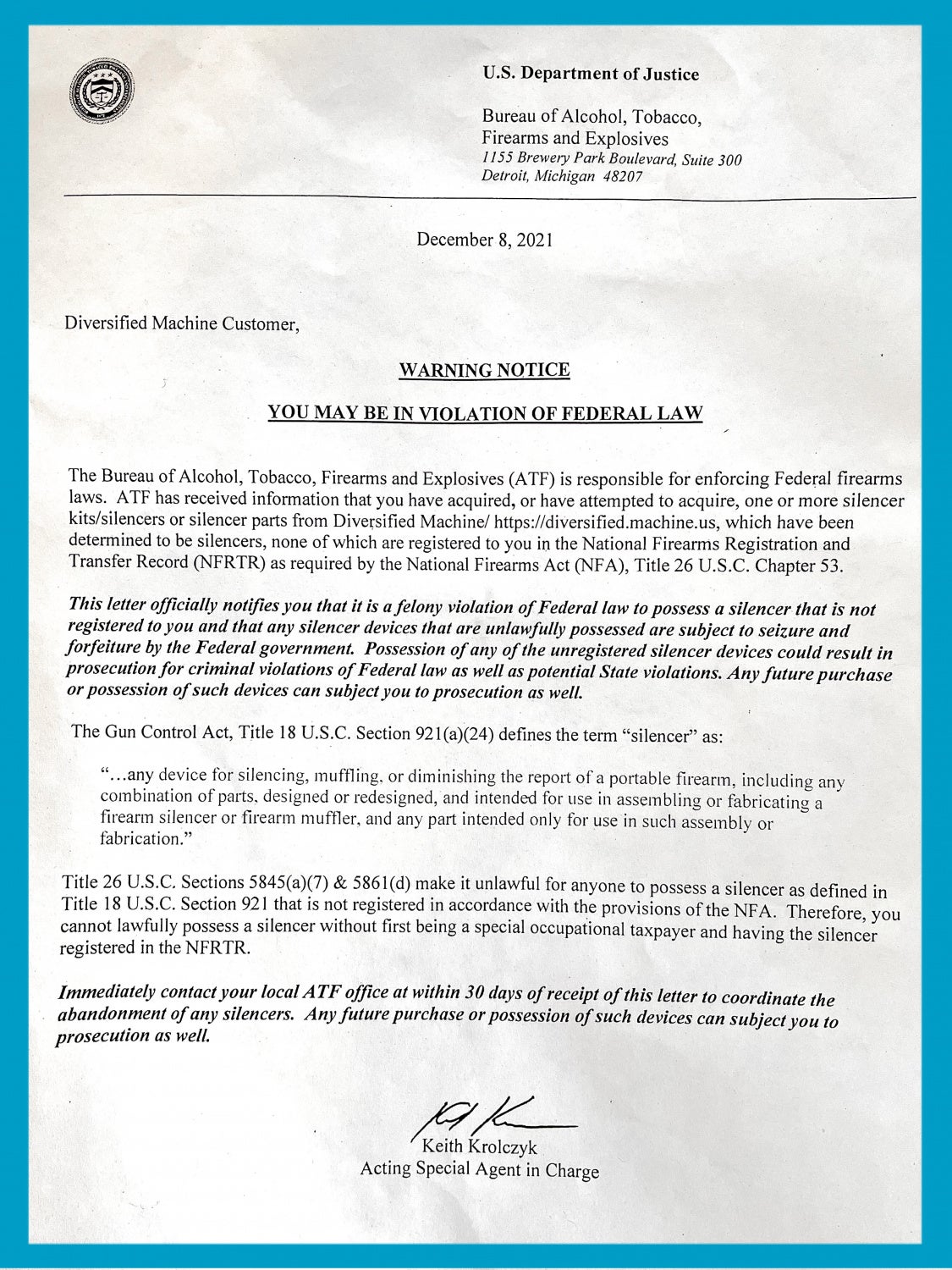
Diversified Machine is one such company and their offices were raided by the ATF in late 2020.  As part of the raid they seized computers and have access to the list of people who bought their products.  Those people have been receiving letters of warning from ATF agent Keith Krolczyk advising that they may be in violation of Federal law. A copy of the letter is below.

SILENCER SATURDAY #209: Solvent Trapped - The ATF Warning Letter

Apparently there are four other companies that are accused of the same violations and their customers will soon begin receiving similar letters. Or at least that is the belief of what is going to happen. It can certainly be nervy to get a letter from the Federal Government accusing you of a felony.  So the question is what should you do and what do you need to know?

1. Don’t panic.  There are literally thousands if not tens of thousands of people who are getting the same letter.

2. While it’s theoretically possible that you could get prosecuted for this, it’s not realistic as the government doesn’t have the resources to go after that many people nor do they have the desire to do so.

3. Be smart, part one. The only people I see getting in trouble for this are those that give a big middle finger to the ATF and ignore the letter or tell them to pound salt over it. The ATF is being very clear that you can’t possess these items and if you try to fight them on it, that’s your right, but it’s a big risk.

4. Be smart, part two. The ATF is asking people to call them within 30 days receipt of the letter to discuss abandoning the silencers.  What is unknown right now is how they want to do that, what they will ask you about your use of this product, what else they might ask you about your life, etc. As the old saying goes, anything you say can and will be used against you. Beyond that, it’s a big crime to lie to a Federal officer.  So the safest play is to get an attorney to make the call for you and arrange for you to discard of these items. Nothing a lawyer says on your behalf is going to be used against you.

5. The letter from the ATF is very poorly worded. It doesn’t say which products from Diversified Machine are thought to be illegal. Surely not everything they sold was illegal. So before you get rid of items that you spent your money on, it needs to be clarified what they are actually talking about.

6. While it can be illegal to possess a silencer, I don’t expect people who aren’t difficult to face charges and it’s possible that even the pains in the butt won’t either.  If you buy a product that is advertised as one thing, the Government would have to prove you knew it was actually something else. Short of you using the device as a silencer in shooting the gun, I don’t know how they’d do that.

The bottom line is that while it’s something to worry about, it’s not something to panic about just yet. You should never speak to an officer without an attorney. If you are an Illinois resident and would like to hire a lawyer to protect you in making this call, please contact us at 312-346-5320. We will refer you to an experienced criminal lawyer who knows gun laws.

If you would like to speak to an experienced injury attorney for free, please call us at 312-346-5320 or fill out our contact form and we will call you.

Here’s something that most people who hire personal injury attorneys in Illinois don’t know. You can fire them if they aren’t doing a good job.  Now you probably shouldn’t do this without having a new firm in place, but if your lawyer has created the impression that once they are hired you can’t get rid of them, they are lying.

So when should you fire your attorney?

For me, if in the first six or so months on a case, there are clear customer service issues, it’s a huge red flag that you hired the wrong firm.  If they aren’t calling you back or not doing what they said they would do, that’s a huge problem.  It’s often predictive that you won’t be happy with them when the case is done and will realize you would have ended up with more money elsewhere.

The biggest worry callers have is that they will owe this bad firm money. In almost every case, if they haven’t filed a lawsuit or obtained a settlement offer, they will get nothing. And even when they’ve done some work, typically the new attorney will end up splitting their fee with the first firm. In other words, it almost never costs you anything to switch although you should of course discuss this with the new firm before you hire them.

I’ve been told that some law firms add clauses to their client contracts that state you can’t get rid of them. Those contracts are illegal and not enforceable even if you’ve signed them.

The reality is that most personal injury law firms in Chicago do a good job and don’t lose clients. We get calls from clients of many of the bad ones. There is one notorious firm that advertises a ton, but then their clients discover that not only are the lawyers in the ads not in Illinois, but they also aren’t even licensed here! They hire local attorneys to handle their cases, but the consumer isn’t getting what they really thought they were. To top it off, I’ve been told that they try to take 40% of what they recover which is insane to me.

Another infamous Chicago injury lawyer has relocated to Florida and has their staff allegedly fax down all information about their cases. Nothing reportedly can happen without their say-so. This of course slows down the case speed and is a prime example of not great service. Needless to say, many of their clients aren’t happy because they can’t get answers.

The other type of call we get a lot is from someone who got into a car accident or had some other injury and they hired a lawyer they used for a divorce, real estate closing, or something not related to injuries at all. That lawyer assures them that they can handle the case. In many instances, the attorney is just thinking of themselves and thinks they can make an easy buck by taking on a case they aren’t qualified to handle.  These cases are much harder than they seem and can involve unique issues like medical liens, hidden insurance, bogus denials, etc.  Before you hire an attorney for an accident, you should ask them how many personal injury lawsuits they’ve filed in the last five years. If the answer isn’t in the hundreds or thousands, you are at the wrong place. And if you realize they are in over their head, you can and should get rid of them.

Bottom line is that it’s your case and your life. You have to do what is best for you and that means getting the best representation possible.  And if that requires you to fire one firm to get another then so be it.

See also: A Secret About Chicago Personal Injury Lawyers

There is a fascinating new documentary on Netflix called “The Tinder Swindler.”  The basic summary of it is that an Israeli man changed his name to Simon Leviev and told women he was the son of a diamond billionaire. That billionaire is a real person, and he does have a son, but it’s not the man who is the subject of the documentary.

He would meet women on Tinder and allegedly tell him that he was the son of this billionaire and begin to date them.  For a couple of them, their first dates involved five-star hotels, private jets, fancy dinners, and other luxuries, all seemingly on his tab.  The reality appears to be that he was telling elaborate stories of his life being in danger and getting these women to send him money, take out loans, give him credit card access, etc. One woman appears to be out around $270,000.00.  All told, he is accused of swindling around $10 million from people all across the globe.

He did some jail time in Finland and Israel for fraud and I believe that if he were to come to the United States where he allegedly conned some people, he’d be arrested here too.

I’ve had phone calls from people looking for a lawyer who have been taken advantage of by romantic interests. Maybe not to this high of a level, but certainly in the five figures. They want to sue their now ex’s and ask me for advice.

While the Tinder Swindler subject is now a free man in Israel, and somehow apparently living a luxury lifestyle again and dating an Israeli model, if it was a similar person in Illinois, suing them would be a challenge.

I say that because you can’t stop a crazy person from being crazy and you can’t stop a scum bag from being a scum bag.  This doesn’t mean that you can’t sue and can’t win, you probably can. What it does mean is that collecting against this type of person would be a challenge.

As a result, hiring a lawyer in this situation probably requires a victim to shell out money to an attorney without a guarantee of a recovery.  If you just lost your life savings, do you want to spend another $5,000-$10,000 or more trying to get a judgment against someone you may never be able to collect from?  Most people wouldn’t.  And while it would be nice to find a lawyer willing to take this case on a contingency basis, most attorneys wouldn’t do that because they know that collecting from a thief is really difficult. It’s one of the flaws of our legal system.

And while I don’t know anything about civil lawsuits in Europe where most of this alleged activity seems to have happened, there is potentially one piece of good news. This apparent fraudster is on Cameo now and reportedly made over $30,000 creating messages in his first few days on the service. In Illinois, if you had a judgment against him you could probably put a lien against his Cameo earnings. Hopefully, it’s the same way over there.

The best advice I can give someone is to try not getting into these situations which of course is easier said than done. While we rarely see situations where someone gets tricked out of giving some more than $5,000 or so, we sadly quite often see them taken advantage of by agreeing to co-sign a loan for someone they think cares about them.  I can’t emphasize enough how bad of an idea it is to co-sign for someone else and highly encourage you to never do that no matter how much you trust or care about someone.  In my experience it ends badly so often that it’s just not worth the risk.

I won’t forget the first day of law school. Honestly not much has stuck with me from most of my classes, but on my first day, a professor pointed out everything that is, or could be, a tort. Walking across the street? That can be a tort.  Driving a car? Tort. Entering a store, working a construction site, eating food?  All of these case be torts. Taking that class in law school made me paranoid and changed the way I looked at the world.

The reason for that paranoia is because a tort can be defined (very informally) as all the crazy/bad stuff that you can possibly imagine happening to someone.

The formal definition of a tort is a civil wrong for which a remedy may be obtained, usually in the form of damages. A civil wrong is a wrong committed against an individual, whereas a crime is a wrong committed against the state.  In plain English this typically means bringing a personal injury lawsuit.

There are four elements to every tort case: duty, breach of duty, causation and injury. In order to have a strong tort lawsuit, there must have been a breach of duty made by the defendant against the plaintiff, which resulted in an injury.

The law of tort protects the rights and freedoms of individuals, as well as their property and reputations. The basic principles of tort law are similar across all states. However, the exact law/rules are determined in each state.

If a plaintiff wins a tort case, the remedies should place him/her (the injured party) in the position he/she was in prior to the tort. Punitive damages are also a possibility to punish extremely reckless or malicious behavior. Basically this means that you should expect to be compensated for your loss. If it’s a car accident that would mean payment for medical bills as well as pain and suffering.

It is very important to hire an experienced attorney who knows the ins and outs of tort law and has demonstrated success in making a great recovery for clients who have similar cases to you. In other words, you don’t just want to hire “the best tort lawyer in Illinois” but instead the best one for what you are dealing with.

Cost wise, a tort lawyer should work on a contingency basis, meaning you don’t pay them a dime out of pocket. They only get compensated if they help you win your case. Some attorneys will seek a fee as high as 40% of the damages they recover. We generally tell people to avoid those lawyers and work with ones who have a fee of 33% which is more typical. Of course since attorneys only get paid if they win, they will want to get involved in a case where you are likely to make a recovery that is worth their while.

If you have any questions about Illinois tort law or would like to speak with an experienced lawyer for free, you can call us any time at 312-346-5320.

A question we get a lot about lawsuits in Illinois and the lawyers who handle them is:

What is your win/loss record?

It’s a sensible question if you don’t know how the legal system works.  You might have a case that one lawyer could get you $5 million on but the lawyer you hire gets $1 million. That’s technically a win, but to us it’s really a loss. This sadly happens all of the time. Who your lawyer is and how good they are is a huge factor as to whether or not you will “win” or “lose” your case.  But there is a much more important factor.

The number one influence of any lawsuit result is, how good are your facts? By far that determines who gets a great result or who feels like they lost at the end of the day. For example, if you are stopped at a stoplight and rear-ended by another car, those are strong facts in your favor. If the other driver was drunk that is even more helpful.  Did you break your leg and need surgery? Those are good facts. Did you just go to the ER and are feeling fine?  Those facts make the case worth less.   If they are driving an Amazon truck, that will make the case worth more money if your injury is serious. If it’s an uninsured driver that will make recovering money from them difficult no matter how great your lawyer is.

You could have the “best car accident lawyer in Chicago” on your side, but if you turn left into oncoming traffic and get hit by a car, they will have a hard time proving the other party wasn’t at fault. You could have the top criminal lawyer in Cook County on your case, but if you are on video robbing a store at gunpoint, getting a not guilty finding is likely impossible.

What great lawyers do with bad facts is make the end result better.  Take the guy caught on video robbing a store.  With a bad lawyer, you are more likely to get the harshest sentence possible. With a fighter on your side, the bad facts make a not guilty unrealistic, but maybe they get you out of jail within a year instead of ten.  That to me is a win.  But even with that great lawyer, facts like your background, family, job, mental health, etc. have a huge role in how a Judge will sentence you.

There are some lawyers that will only work with the best facts. These are firms that get the best personal injury cases that are usually worth in the seven figures and don’t always require a ton of hard work. Why would they take on a tough case when they make a lot of money off of easy cases with huge damages?  The point is that when the facts aren’t perfect, you need to really have a fighter on your side.  And in reality, you need that when the facts are good too because at some point there will usually be a hiccup and cases are worth more or do better when the lawyer really cares.

Two out of every five Americans will need long-term care at some point in their lives. Sadly, senior citizens are sometimes victims of abuse and neglect (both intentional and unintentional) within nursing homes and assisted living facilities. While it is difficult enough to place a family member in a home, it is even more difficult to see that family member suffer under the care of an overburdened, under-trained or abusive nursing home staff.   Even worse is when you feel like the staff doesn’t care about the health of their patients.

We get calls, chats and emails regularly from people asking, “Is this a nursing home case?” Here are some of the questions we ask to determine if people do have a case.

  1. Where did the injury occur? We need to know the exact location. Often people come in to a nursing home with physical problems already. Other times they are in a nursing home, but maybe got sent to a hospital for one reason and developed a bed sore there. Furthermore, at what facility did the injury occur? Unfortunately, there are some nursing homes and assisted living facilities in the state that have a reputation for being understaffed and inattentive to their residents.  Sometimes when we hear the name of the facility it’s a good indicator that a screw up occurred because we do see the same names over and over.
  2. Who is the injured party? What exactly is the injury?We always ask for the details of the injury. Who is the family member you are calling about? Tell us exactly what happened or what you observed. Potential nursing home negligence includes:
  • Unexplained bruises, cuts, burns, sprains, or fractures
  • Bedsores or frozen joints
  • Dehydration and malnutrition
  • Unexplained venereal disease or genital infections; vaginal or anal bleeding; torn, stained, or bloody underclothing
  • Falls from the bed
  • Staff refusing to allow visitors to see resident or delays in allowing visitors to see resident (unrelated to Covid)
  • Staff not allowing residents to be alone with visitors
  • Resident being kept in an over-medicated state
  • Falls by patients who are supposed to be assisted when walking
  • Patients who get dropped and injured by nurses
  • Failure to diagnose an injury or disease
  • Sexual abuse
  1. When did the injury occur?Or when did you first notice the injury/neglect? There are statutes of limitations for nursing home injuries in Illinois. It is typically two years from the incident date although there are some exceptions. The longer you wait the harder it can be to prove a case as we often rely on testimony from the patient themselves and serious injuries can affect memory.

Helping people determine whether or not they have a case is part of what we do. Another part of our free service is to point people in the right direction if they do have a case. With nursing home cases, it is critical to contact/hire an experienced attorney who specializes in them. If you would like to talk to an attorney for free about a possible case, please call us any time at 312-346-5320 or fill out our contact form and we will call you. Every attorney we recommend has a track record of success and they only get paid if they win the case.

We as lawyers don’t expect the public to know what the law is and don’t blame them when they think the law is one thing when it really is something else. The most common example of that happening is when someone calls and wants to sue for a civil rights violation.

Often people think that being treated unfairly is a violation of their civil rights. For example, maybe you have treated with a doctor who no longer wishes to treat you or your landlord wants to end your lease.  Those situations on their face are not civil rights claims. A civil rights lawsuit has to show that a protected class has been harmed due to their status as part of a protected class. These violations occur if a person has had their granted freedoms taken away or is discriminated against based on:

  • Race
  • Color
  • Gender
  • Age
  • National origin
  • Disability
  • Sexual orientation
  • Religion

So if you are denied the chance to buy a house because of the color of your skin, that would be a case. If you are being sexually harassed at work, that could be a lawsuit.  If you are denied entry in to a restaurant because you are gay, that could be a case.

The most high profile of these lawsuits are when the police use excessive force, often based on discriminatory reasons. Those are also civil rights claims, either under Federal or Illinois laws.

The purpose of civil rights laws is to protect people against discrimination. So to show you have a case, you have to prove that you were discriminated against. You can’t just suspect it’s true, you have to have evidence. So if you think you were fired because you are 60, knowing in your heart that it’s true isn’t enough. An email or statement that says they are getting rid of you because you are too old would be needed or circumstantial evidence like the only workers being fired are over 40. It’s not illegal to fire an older person, but it is illegal to do it because they are old.  You have to prove your case.  The defendant doesn’t have to disprove anything.

These cases can be difficult to prove since most people don’t come out and announce that they are choosing to discriminate against you. But it’s not impossible. If you would like to speak with a lawyer for free to see if you have a case, you can fill out our contact form or call us at 312-346-5320.

There is a famous Chicago family law firm that does a lot of advertising and they get a lot of cases.  They also end up with a lot of unhappy clients.  That’s because while their marketing makes people think they are one thing, it quickly becomes obvious that if you hire them you are going to be ripped off.  I’ve seen divorce cases they’ve handled where before the first court appearance is made they’ve billed over $10,000.00 in legal work on a not complicated case.

What happens apparently is that they will bill their clients for “research.”  While there are some cases where research is needed, most family law cases don’t require it.  If you are a lawyer and have to bill for research in to child support statutes or custody law, then you must be handling one of your first cases.  This “research” is not the same as a client who brings some unique issue forward such as determining the international custody arrangement the United States has with a country like Morocco. That’s not an issue that comes up more than once in the lifetime of most lawyers and would be legitimate.

So does this mean that all lawyer research bills are ripoffs? No.

The most common, legitimate legal research that takes place for the average person who hires an attorney comes in two cases. The first  is criminal law.  If your attorney can find a case that has gone to the Appellate or Supreme Court and can help you avoid jail then that’s worthy research. I’m not talking about minor retail theft situations. I’m referring to major felonies that can result in long jail time.  The catch is that if they’ve done the research on one case, confirming their findings haven’t been over-turned by a new court case should not take more than 30 minutes or so.

The other common area of legit research is in civil cases. If you are trying to argue for or against a motion for summary judgment, research in to similar situations makes a ton of sense and can be the reason you win or lose a case. It’s especially relevant when the Judge is asking for a legal brief in support of your argument.

So what should you do to make sure your legal bills aren’t inflated with bogus research charges?  Here are some tips:

  1. Before you hire the lawyer, ask if they anticipate billing for research. If the answer is yes, ask what for.
  2. It’s not inappropriate to ask that they contact you for approval before billing for significant research.
  3. If your bill has a charge that simply says “research” and doesn’t explain what was done, ask them to clarify and provide a copy of the research results. Most legitimate research will result in some sort of a memo, especially at a larger firm where more than one person is working on a case.
  4. If it happens, ask why a more expensive senior lawyer is billing for research instead of a paralegal or cheaper associate.
  5. Most importantly, if the research you are billed for seems basic (e.g. they charge you to look up child support rates), call them out on it.

The good news is that most lawyers are honest, but I’ve seen enough cases where legal bills are severely inflated that you have to be on the lookout.

Most people are familiar with the term commission. In certain jobs, especially sales jobs, the compensation arrangement typically includes commission pay. An employee may receive a salary, or some level of guaranteed base pay, but the commission pay over and above that, is dependent on how many goods/services the employee sells. Commission plans vary by company and position, but the underlying premise is the same. Performing at a high level and selling more equals more money in that employee’s pocket.

Seems straightforward, but we have encountered many questions from employees over the years about their commission. Let’s take a look at some of them.

  1. I had a rough week with low sales and made very little commission. Is there a minimum my company has to pay me?

Yes, there is. A Fair Labor Standards Act (FLSA) was first introduced in 1938 to protect workers. It had laws regulating child labor, setting the number of maximum weekly work hours, and establishing a minimum wage. Obviously, laws have evolved since then, but your company is required to pay you the current minimum wage when your weekly pay is averaged by the number of hours you worked. The minimum wage is currently $11.00 per hour in Illinois.

For example, let’s say that during your rough week, your commission averages only $5.00 per hour you worked. Your employer must pay you an additional $6.00 per hour to make up the difference between that and the minimum wage.

  1. My employer and I agreed that they would pay me commission but now I’m not getting paid. Now what?

Do you have a clear agreement with your employer about commission pay? Is the rate of commission in writing? If so, your first step is to notify your employer in writing that you aren’t receiving your commission as promised. If your employer does not comply, the next step would be to contact an attorney. Illinois has a law that ensures employees seeking their unpaid commission will be reimbursed for their attorney’s fees.  The lawyers we recommend for these cases never ask for a penny up front and only get paid if they make a recovery for you.

  1. I earn commission, and I worked 55 hours last week, but my company did not pay me overtime. Do they have to?

That depends on a few things. Are you an inside or outside salesperson? If you spend more than half your working hours making sales outside of a central office, you are an outside salesperson and don’t qualify for overtime. If you are an inside salesperson, you still may not be eligible for overtime if you work in a retail or service establishment, if your pay rate is higher than 1.5 times the minimum wage (i.e., $16.50 in Illinois) and if over half of what you earn comes from commission.

Are you in a similar situation? Or do you have a question that is different from the ones above?  Do you just want to speak to a lawyer for free? Whatever your situation, you are welcome to contact us any time at 312-346-5320 for a confidential consultation.

Happy New Year!  Did you know that there are over 300 new laws that just went into effect in Illinois?  A lot of them won’t come up in your life, but a bunch are going to be relevant to a lot of people. Here are some that I think will have a big impact and some of my thoughts:

– If you ask for medical assistance for an opioid overdose, you will be immune from prosecution for possession of those drugs.  Great idea, now expand it to all drugs.

– Non-compete clauses are banned for people making less than $75,000.00 a year. This is a great start, but I personally think the limit should be higher and the length should be reduced to a year.

– Minimum wage is up to $12 an hour and is on its way to $15 an hour.

– No contact orders now also include email and social media. I can’t believe this wasn’t already the case.

– Expecting mothers can now use handicap stickers for up to 90 days in the third trimester.  Hopefully, this doesn’t get abused by family members, but helping pregnant women is always a good thing.

– Restaurants have to serve water, milk, or juice as the default beverage on kids’ meals rather than soda.

– Schools are banned from discriminating against kids whose hairstyles reflect their racial, ethnic, or cultural traditions.

– Companies can no longer charge early termination fees for customers of telephone, cellphone, television, internet, energy, medical alert system, or water services who die before the end of their contracts.  I can’t believe they would do that, except I have AT&T so I can totally believe it.

– Pubic school students can have up to five mental health days with no doctor’s note required.

– Public universities can no longer make prospective students submit ACT or SAT scores.  Google the bias in those tests and you’ll likely agree this is a good idea.

– Health departments can’t regulate lemonade stands run by kids under 16.  Who in their right mind would do that?  Obviously someone did, as this seems like a reactionary law.

– Counties and cities with populations greater than 500,000 will require all law enforcement officers to wear body cameras. All officers in the state will be required to wear them by the beginning of 2025.

These are 12 of the most impactful ones in my opinion. As always, if you have questions about any Illinois laws or want to speak to an attorney for free, call us at 312-346-5320.

I get asked a lot of relatively random stuff.  Some people want to do things they shouldn’t and others just have great questions. Here are five scenarios we’ve come across recently that are good to know.

1. I got an alert that a sex video of me was posted on the internet. I’m assuming it was done by an ex-boyfriend. How can I get this taken down?

This is known as revenge porn and it’s now a felony in Illinois.  You can certainly sue the website that is hosting it, but a better first step would likely be to go to the police and file a report. Hopefully they will arrest the ex.  In general, you should never pass around or post a sex tape whether it was filmed in a consensual way or not. Better advice is to just never make a sex tape.

2. I got my first speeding ticket ever. I thought it was not a big deal and I’d just pay a fine, but when I went to court, the Judge said I could go to jail. What’s going on and how do I fix it?

This person was charged with aggravated speeding, in this case it was 92 in a 55.  Aggravated speeding is any charge 26 miles or more over the limit. Once you hit more than 35 over as in this case, it’s a class A misdemeanor punishable by up to a year in jail and a $2,500 fine. The good news for this person is that they have a clean record. In many cases, an attorney can get the charge reduced so you avoid jail. You’ll still pay a fine, but not as big.   Everyone speeds, but once you are in the 20 over range you should really be careful.

3. Last year I was hurt at work and scheduled for surgery. The insurance company sent my records to some doctor in Florida and now they’ve denied my treatment.  Is this legal?

It is. The process is called “Utilization Review” which is a fancy term for sending your records to a doctor who doesn’t examine you.  Often these are semi-retired hired guns who will say what the insurance company wants. It’s shady because they can send your records to as many doctors as they want until they get the answer they want. And you don’t know it happened until they find one against you. Nine doctors could be in your favor, but you’ll only hear about the 10th who isn’t.  The good news is that when compared to a credible treating doctor it won’t have much weight. But it is legal and can delay your care.

4. My girlfriend is pregnant and just got fired. Is that legal?

It’s not legal typically to fire someone because they are pregnant, but not against the law to fire a pregnant person. So she’d have to prove that she was fired for that reason which is often easier said than done.  If she suspects it, but doesn’t have hard evidence, she can/should file a complaint with the Illinois Department of Human Rights or the Equal Employment Opportunity Commission.

5. My Dad had two families. He had three kids with my mom and they divorced. He then married another woman who didn’t like us and had two kids with her. She died two years ago and my Dad just passed away.  His will was created ten years ago and leaves everything to the newer kids. He told me that he didn’t want to make waves with his wife. Can my siblings and I contest this will?

Anyone can contest anything, but it doesn’t sound like they have a good leg to stand on.  There is no law that requires a parent to leave anything to any children and they can cut off some and not others. You’d have to show that the will was fraudulent or that he didn’t know what he was doing when he signed it. That doesn’t sound like the case in this situation.


If you have any questions about these situations or anything else related to Illinois law, you can call us for free to speak with a lawyer at 312-346-5320.

Getting a divorce in Illinois can be very stressful, not only because of the emotions involved, but also because of the unfamiliar legal terminology and issues that arise throughout the process. Commonly asked questions by people starting the divorce process are, “What exactly is spousal maintenance? How does it work?”

Spousal maintenance is financial assistance (money) that one spouse is ordered by the court to pay to the other spouse after a divorce. You’ve probably heard it referred to as alimony, but in Illinois it’s called maintenance.

While two people are married, it is assumed that they share their wages and support each other. In most cases, one spouse’s income is greater than the income of the other. The other spouse may work full-time at a lower-paying job, work part-time, or take care of the children and not have a job outside the home.

With spousal maintenance, the spouse who earns the higher income often must make payments to the spouse who earns the lower (or no) income so that he/she can be at a similar standard of living as to when the couple was married. When both spouses work and have similar incomes, spousal maintenance may not be called for.

The next step is to determine the amount and duration of spousal maintenance. The primary factors considered are: 1) the spouses’ income levels and standard of living; 2) the earning potential of both spouses; and 3) how long the couple has been married.

For example, let’s say there are two couples, Couple A and Couple B. Both couples have one spouse that works full time and the other is a stay-at-home parent. The income for Couple A is $150,000/year, and the income for Couple B is $50,000/year. If all else is equal, the stay-at-home parent in Couple A will get a higher amount of spousal maintenance than the stay-at-home parent in Couple B.

However, if the income levels of both couples are similar, and the stay-at-home parent in Couple A has a master’s degree, and the stay-at-home parent in Couple B only has a high school diploma, the stay-at-home parent in Couple A has the potential to get a higher-paying job. Therefore, he/she will get spousal maintenance for a shorter duration than the stay-at-home parent in Couple B.

Finally, how long the marriage has lasted influences the amount and duration of spousal maintenance. If all else is equal, and Couple A has been married for 18 years and Couple B has been married for 2 years, spousal maintenance will be higher in Couple A. In fact, the judge may not award any spousal maintenance in the case of Couple B because of the short length of their marriage.  It’s to maintain a lifestyle you’ve grown accustomed to and that’s hard to do in two years.

Every couple’s situation is unique. If you’d like to confidentially discuss divorce or spousal maintenance with an attorney for free, please call us any time at 312-346-5320.

One thing that is true about dealing with insurance companies is that they are not looking out for you. Whether it’s your health insurance, car insurance or something else, the main goal of the company is to limit how much they pay on your behalf.  Sometimes they will tell fantastic lies to further their ends.  I heard a real doozy recently from an injured Illinois worker.

This very nice woman had broken her arm.  She regularly worked 60 hours a week, but was only getting work comp benefits based on a 40 hour work week. When she asked about the extra pay, she was told (wrongly) that overtime isn’t included in work comp payments.  She responded by saying that she wanted to ask a lawyer if this was true and the adjuster went off on her. “If you get a lawyer that will make the case drag on for two more years and they’ll take your money!”

Both of those things aren’t true. First off, the length of a case depends on your medical recovery. The only time getting a lawyer makes it last longer is if you are getting screwed over and we go to arbitration to get you tens of thousands that you are missing out on.  In most cases having a lawyer makes things go faster because we stop the insurance company from playing games and allow you to focus on your health.

As for the second lie, attorney fees in Illinois work comp cases are capped at 20% of what is recovered for your settlement or trial verdict.  In almost every case, you end up with more money by getting a lawyer than if you didn’t have one, even after the 20% fee.  This is a common insurance company lie to try and screw you out of money that they owe you.

This isn’t a one off situation. It happens all of the time.  Later the same day I got a call from an Amazon worker who was dealing with their insurance company, Sedgwick. Whoever she talked to told her that there had been a “global settlement” of their work comp cases and that she had been allotted a certain amount to resolve her case. It was basically implied that all of the cases were getting settled together and that this worker had to take what was a low ball offer.

This was a lie I’d never heard before, but it’s absurd. Work comp cases aren’t class actions. Everyone’s case is their own and you don’t have to take less because all of the cases are resolving at once. They aren’t doing that. Your case settles whenever it’s ready and you get paid whatever it’s worth. Or at least that’s how it’s supposed to work. Their lies might try to avoid that, but if you know your rights you won’t fall for their tricks.

The bottom line is that generally speaking insurance companies don’t look out for you and shouldn’t be trusted. Even when they are nice, they have an agenda, so be careful.

If you would like to speak to an experienced Illinois lawyer for free, call us any time at 800-517-1614.  We help with cases everywhere in Illinois.

Free Case Review
From Our Attorneys

Archives